

share

From Migration to Agribusiness at Home: Nicolae Susan Exports GLOBALG.A.P.-Certified Table Grapes to the EU
For many small and medium-sized producers in the Republic of Moldova, access to the European Union market can seem difficult. The story of Nicolae Susan, a table grape producer from the village of Ursoaia in Cahul district, shows that this path can be successfully navigated when cooperation and professional support are in place.
After working several years abroad to support his family, Nicolae decided to return to Moldova and invest some of his savings in agriculture. In 2006, he planted his first hectare of table grapes. Over time, the plantation expanded gradually, year by year, financed exclusively from his own resources.
Today, the farm cultivates six hectares of table grapes, primarily the Moldova variety, and operates its own cold storage facility - essential infrastructure for preserving quality and ensuring proper market valorisation.
“We did not choose the Moldova grape variety by chance. As a producer, I know that you can grow good grapes, but without storage, irrigation and technological discipline, you cannot access the EU market. Fortunately, we formed a group of producers, guided by specialists and an experienced exporter. Thanks to this cooperation, we obtained GLOBALG.A.P. certification and our ‘ticket’ to export,” Nicolae Susan explains.
.jpg)
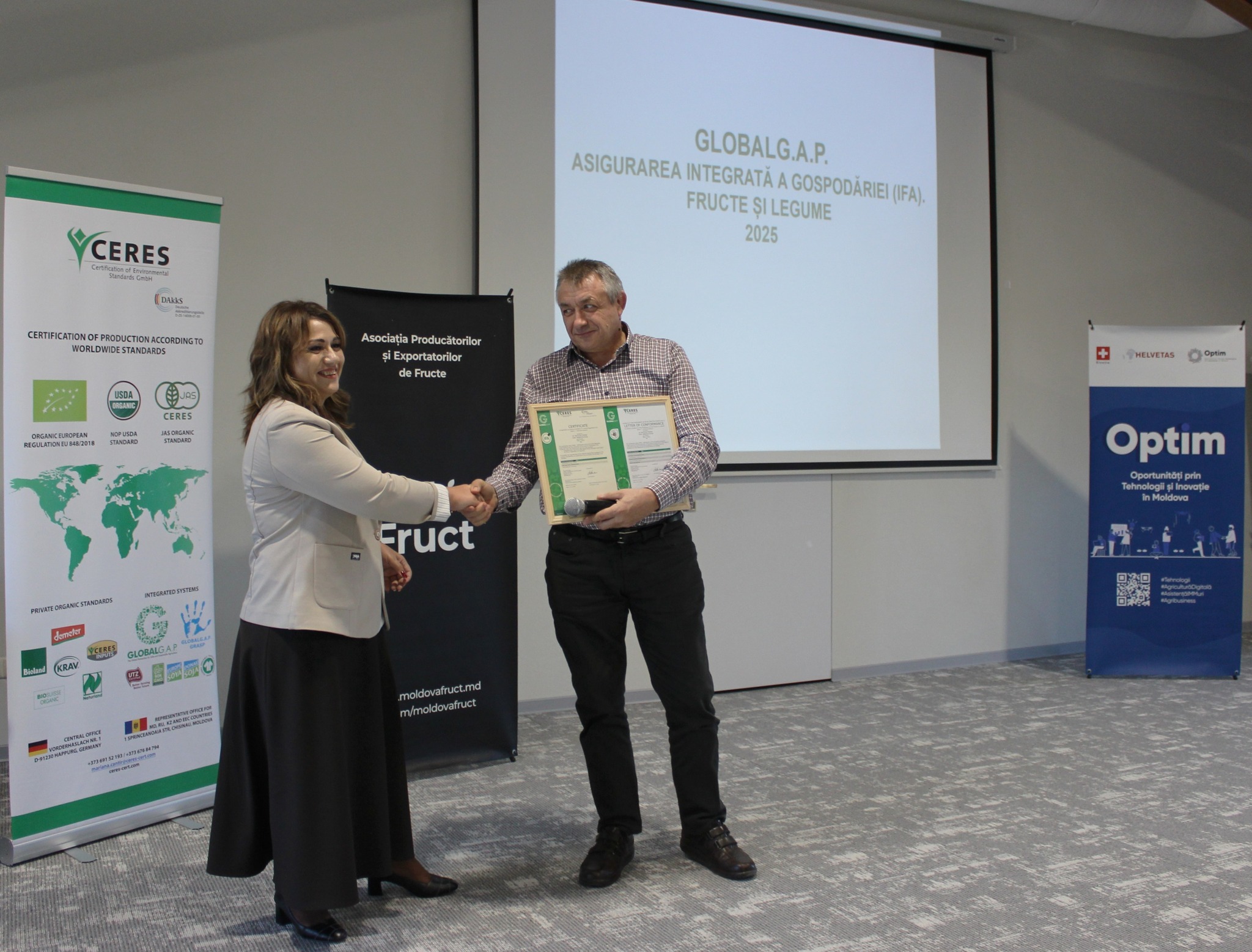
Throughout 2025, Nicolae worked within a structured cooperation model facilitated by Moldova Fruct Association, in partnership with the exporter Mialex Nord. At the end, producers obtained GLOBALG.A.P. certification through a comprehensive programme of training and technical. This model enabled producers to harmonise their production technologies, phytosanitary treatments, record-keeping, and hygiene practices.
“GLOBALG.A.P. certification changed the way we work. As a group, we managed to comply with all procedures, which allowed the exporter to deliver our grapes directly to Germany and Poland,” the producer emphasises.
Today, the farm is a family business, with Nicolae’s son actively involved. Future plans include expanding the plantation, investing in irrigation and infrastructure, and maintaining international certification standards.
.jpg)
The cooperation model implemented in 2025 represents the first functional example of integrating small table grape producers into an EU-oriented supply chain. Its success opens the door for scaling the approach to other crops, including plums.
This initiative was implemented by Moldova Fruct Association, with the support of Switzerland and Helvetas Moldova, through the OPTIM Project.
Related readings