


share

Reimagining Agriculture: How One Moldovan Farmer Learned to Listen to His Soil
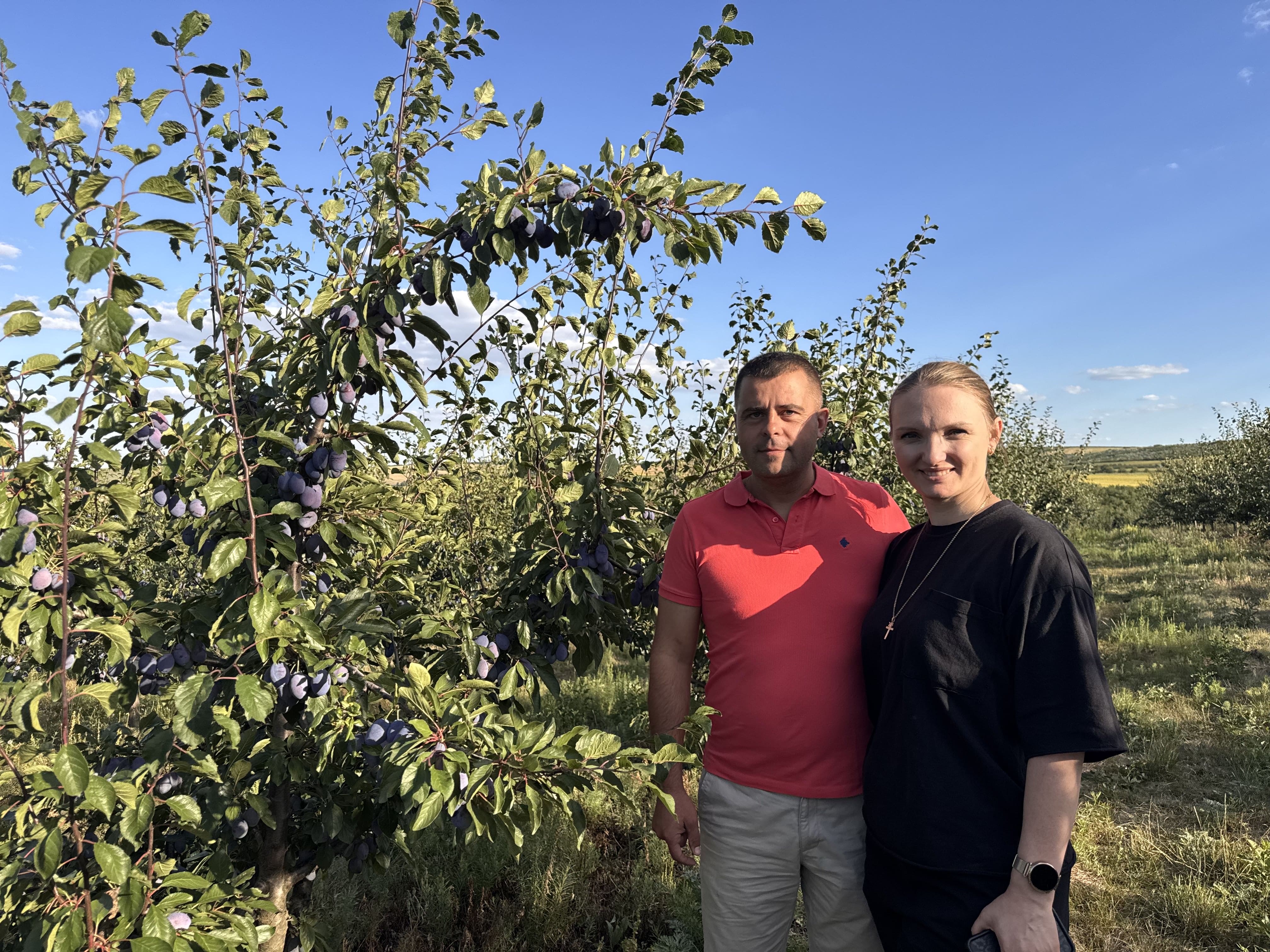
In the village of Olișcani, in Șoldănești district, Vadim Rabii spends much of his time among his plum trees. He farms six hectares of orchard and another thirty hectares of cereals. If you ask him why he chose this life, the answer comes without hesitation: “Time spent in the field is the greatest happiness I have." For many years, that happiness was put on hold. Vadim spent sixteen years working in Italy, in agriculture, for the same employer. It was steady, familiar work, but it wasn't his own land. Watching opportunities open up back home, he decided to return to Moldova and build something for himself. His first plum harvest was modest and was dried for the local market. But things began to change. Over the past two years, his fruit has reached export markets, including Italy. Reaching European markets means competing on more than price. Farmers need consistent quality, careful use of plant protection products and a better understanding of what goes into the fruit they sell.
A Change That Went Into the Field
Sixteen years of agricultural work abroad gave Vadim plenty of practical experience, but coming home also showed him how much he still had to learn. “The biggest problem, one I didn’t even realise was a problem, is that we start from the top,” Vadim says. “But we should start from the bottom. We should begin by looking at the soil’s actual properties, and everything else after that.”
For farmers, access to soil and water testing is essential to understanding what a crop truly needs and making informed, data-driven decisions. Laboratory analyses can provide valuable insights into soil properties and water quality, helping farmers use fertilisers and crop protection products more efficiently.
In this context, OPTIM has supported improved access to testing services and agricultural advisory support. The intervention included access to mobile laboratories, which enable preliminary soil and water analyses to be carried out directly in the field, as well as information sessions for farmers.
Vadim says that participating in the training sessions, combined with access to testing services, has changed the way he approaches farming. Together with 30 other farmers, Vadim and his wife learned how to collect and test soil and water samples properly, interpret laboratory results, monitor pests, and apply crop protection products only when necessary.
Marius Mocanu, a representative of Ecology Centre, a Moldovan company supported by the Government of Switzerland and Helvetas Moldova through the OPTIM project, says that one of the most significant changes he has observed is farmers’ growing interest in better understanding what is happening on their own land.
“After we ran the training programmes, we saw a real increase in farmers’ interest in what is actually in their soil, what is in the water they use for spraying, and what they can do to reduce insecticides, herbicides and fungicides in favour of more ecological methods,” says Marius Mocanu, representative of Ecology Centre. “Farmers simply don’t have enough information to know what to do, and when, to get a harvest free of residues.”
What makes the training different, he explains, is that it doesn't stay in a classroom. "We show them how we take the samples and give them a preliminary look at the sodium levels and the metals in the soil or the water. It opens their eyes, " Marius shared. Vadim remembers discussing each session with his wife on their way home. “It really was a benefit,” he says. “Driving home, we’d talk about how much transparency there was. We learned something new from every single session.”
What the Data Changed
One of the clearest changes happened in Vadim’s approach to pest control. Before the training, he treated his plum trees roughly every six to ten days. It was a routine familiar to many farmers: spray at regular intervals to avoid taking a risk. Then he started using pest-monitoring traps. Every day, Vadim checked what was happening in the orchard. If the traps showed no threat, there was no reason to spray. At one point, he went twenty-five days without a treatment. “Now we’re sure what the soil actually needs, and that’s exactly what we give it. We saved a lot of money,” he says.
For a farmer, fewer unnecessary treatments mean lower costs. Marius sees the same change among other farmers. “Many people think a soil or water test is just money thrown to the wind. It isn’t,” he says. “A water and soil analysis cuts costs enormously, especially for fertiliser, and it puts far less stress on the land itself.”
Part of a Larger Effort
What happens in Vadim’s orchard is also connected to a bigger challenge for Moldovan agriculture: becoming more competitive in European markets. European buyers increasingly expect producers to demonstrate quality, traceability and responsible use of agricultural inputs. For small and medium-sized farmers, meeting these expectations begins long before the fruit reaches a border. It begins with decisions made in the field — what is in the soil, what is in the water, when a treatment is really needed and how much fertiliser to use.
Through the OPTIM project, Helvetas Moldova and the Government of Switzerland have supported Ecology Centre in developing its soil and water testing services from an initial pilot into a service that can reach more farmers, including during the busy spring and autumn sampling periods. For Vadim, the practical payoff is already visible in the orchard: fewer unnecessary sprays, lower costs, wiser use of fertiliser, and a farmer who has learned to finally listen to his own.
Related readings


