

share

Business Consultancy in Moldova and How ACAM Academy Is Changing the Game
“Moldova needs a solid network of professional consultants who understand local realities while remaining connected to international expertise, standards, and trends.” Simone Di Stefano, Deputy Director of the Swiss Cooperation Office in Moldova
New doors are opening for small and medium-sized businesses in Moldova. EU accession process is already reshaping markets, and Moldovan small and medium producers can now realistically target European shelves. For local manufacturers, bidding for cross-border trade is a real opportunity, and it is transformative. And it is transformative systemically. Higher-value markets demand higher standards. Hand in hand with high standards come product regulations, complex financial compliance, rapidly shifting marketing expectations, and lean supply chain requirements. For a micro or small enterprise, meeting these demands without a full‑time economist, marketing specialist, lawyer, or supply chain expert on payroll is a steep climb. The very opportunity that beckons also raises the bar for entry.
This is where a business consultant becomes a game changer. Business and management consultants come with specialised, hands-on expertise that helps SMEs clear that bar affordably. A good consultant reduces the cost of compliance, brings cutting-edge methods, and introduces fresh approaches because they live and breathe these domains every day. For SMEs, they turn what looks like a burden of regulations into a manageable roadmap. In short, Moldovan entrepreneurs no longer have to choose between dreaming of European markets and drowning in their requirements, because with a trusted advisor, they can do both.
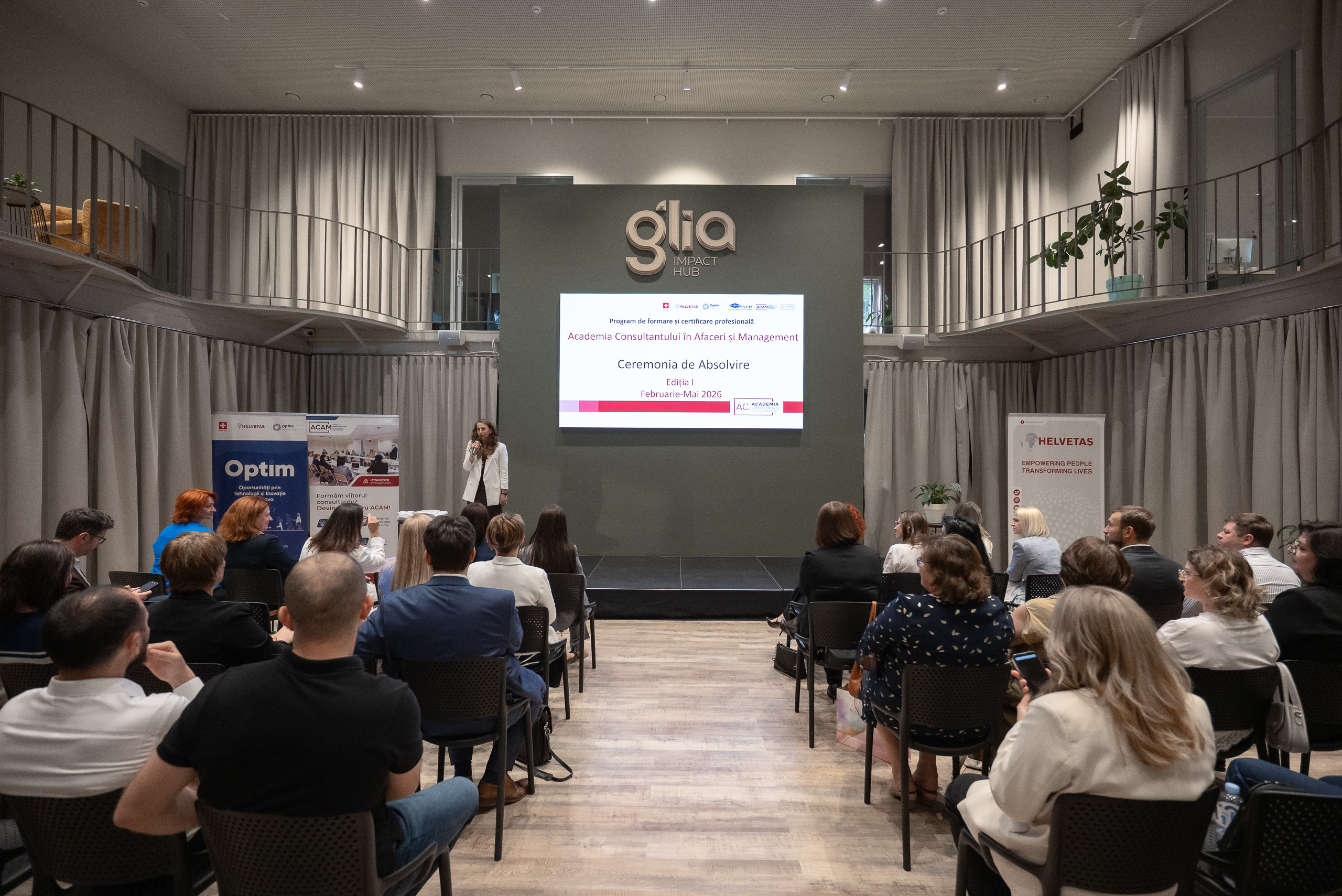
ACAM Consultant Academy curriculum covered nine modules, including: foundations of the consulting profession and international standards, business strategies and models in consulting, financial management, project and stakeholder management, marketing of consulting services, applied methods and techniques, digital transformation and responsible AI integration, value-based selling, and change management in organisations. After intensive training, on 28 May 2026, 29 consultants completed the program on 28 May 2026 and received their diplomas.
What does the 2022 study reveal about consulting in Moldova?
As shown by the 2022 ODIMM, ProAfaceri, and ACAM study, there has been almost no structured cooperation between universities and the consulting field in Moldova. For instance, there were no MBA‑level programs, no formal training for young consultants (p. 9, p. 28). The same report states that the market has grown: 551 registered firms, a combined turnover of 28.2 million EUR, and profit up 13% from 2019 (p. 6). But growth alone does not solve the real problem. According to the study, pseudo‑trainers who pose as consultants easily win clients’ trust through polished communication and promises of “overnight success,” offering universal “practical” solutions that turn out to be ineffective or isolated, where complex and tailored approaches are needed (p. 28). As a result, serious consultants struggled to compete, and many SMEs ended up with advice that is useless or even harmful. Roots of the problem lie in the absence of professional standards or minimal entry requirements; as a result, anyone could call themselves a consultant (p. 9, p. 41). International certifications (CMC, ISO 20700) were still rare, though growing (p. 11–12). So when a small exporter needed trusted help to reach European shelves, the market offered plenty of names but no reliable signal of who actually knew what they were doing.
Why does a Consultant Academy matter?
That gap between supply and trust is exactly what the Consultant Academy was built to bridge. The Academy is an initiative of the Association of Business and Management Consultants (ACAM). Together with the Academy of Economic Studies of Moldova (ASEM), the country’s top economics university, and with support from Helvetas Moldova through the OPTIM project, ACAM developed a mini‑master program in business consultancy. The program received accreditation from ANACEC (National Agency for Quality Assurance in Education and Research), a formal recognition that the curriculum meets rigorous academic and professional standards.
Accreditation does more than simply validate a syllabus. It legitimises the profession. When a client, from a small farm to a larger company, sees a consultant holding a diploma from the Consultant Academy, they know that person has undergone structured training, been tested on real‑world cases, and committed to a code of ethics. Thus, gradually, trust becomes possible.
For a small Moldovan exporter aiming at European shelves, a reliable consultant can mean the difference between a rejected and a signed contract. As the business environment becomes more complex, the demand for trusted advisors will only increase. International experience shows that “partnering with an experienced business consultant can be the key to unlocking growth opportunities” (Crescendo Worldwide, 2026).1 Strengthening ACAM’s Consultant Academy is therefore an investment not only in local businesses but in Moldova’s capacity to compete globally.
References:
Crescendo Worldwide (2026). Why Business Consulting Services Are Essential for Global Growth
Lobanov, N. & Zubco, R. (2016). Dimensiunile cantitative si calitative ale pietei serviciilor de business-consulting din Republica Moldova
Nistor, D. (2011). Management of the Moldovan Small Consulting Firms
Related readings